SEO title: Osseointegration Explained | Dental Implants in South Surrey
Meta description: Discover why your body accepts titanium dental implants, how implants bond with bone, and how long they last. Learn about implant dentistry in South Surrey.
URL slug: /osseointegration-dental-implants-south-surrey
Primary keyword: Dental implant osseointegration
Secondary keywords: Titanium dental implants, ceramic vs titanium implants, dental implant success rate, dental implants South Surrey, dental implants White Rock, bone healing around dental implants
Understanding Osseointegration: Why Doesn't the Body Reject a Dental Implant?
When a foreign object enters the human body, the immune system may react by causing inflammation, forming scar tissue around it, or trying to remove it. Yet dental implants, usually made from titanium, can remain firmly anchored in the jawbone for decades.
Why does the body accept a titanium implant instead of rejecting it?
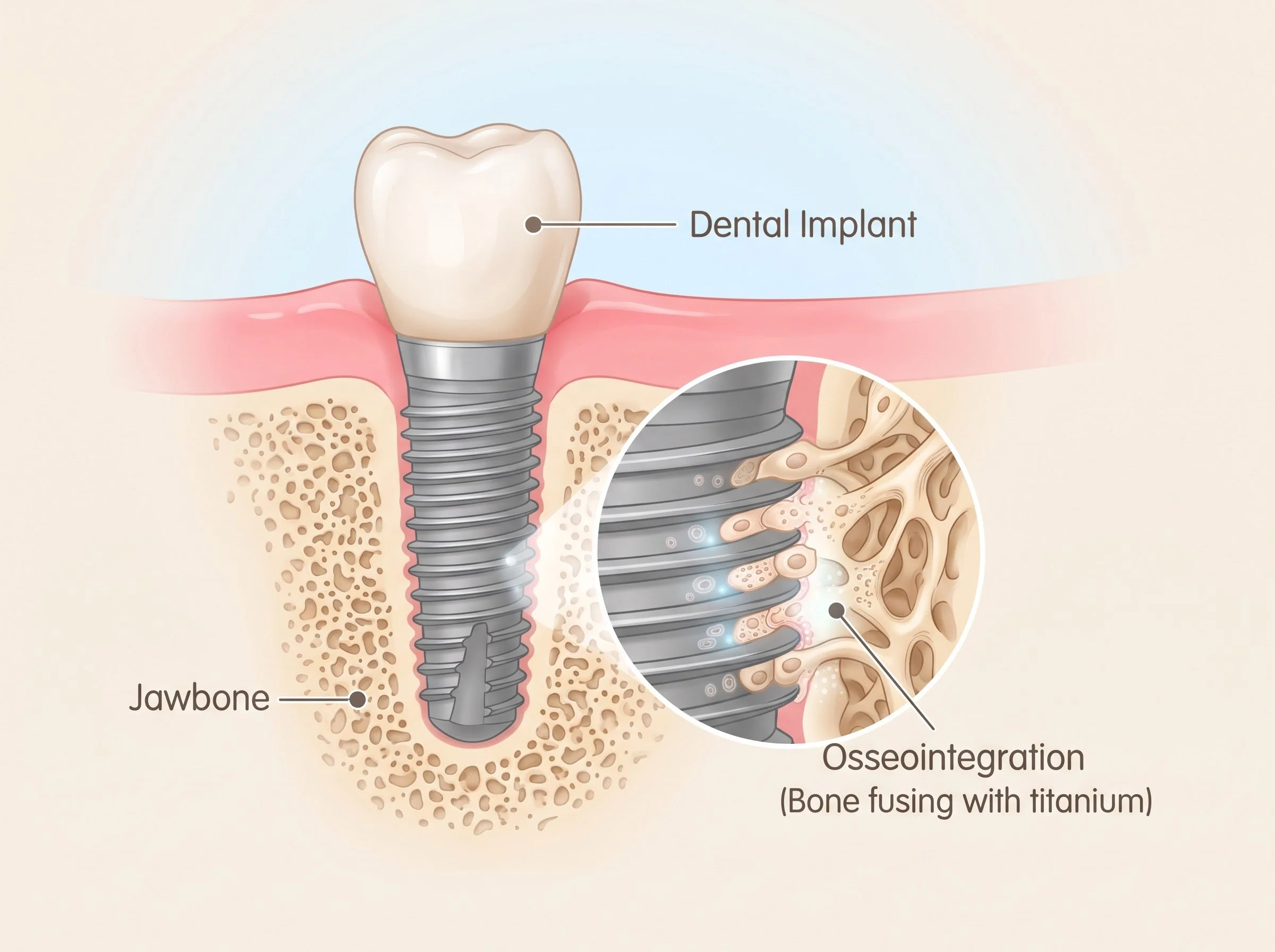
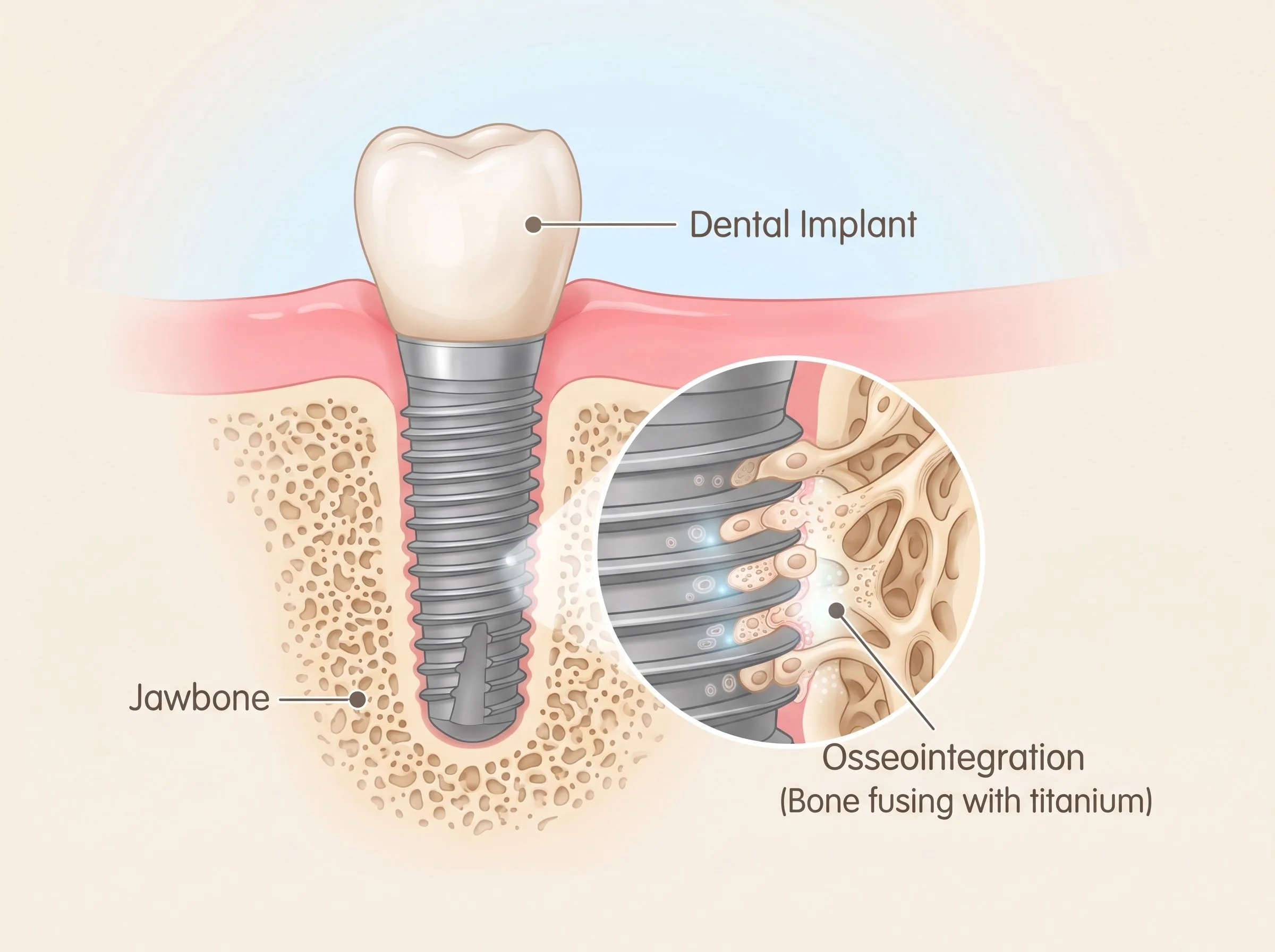
The answer lies in a remarkable biological process called osseointegration, in which living bone grows directly onto the implant surface, creating a stable connection that can support a replacement tooth.
The important role of titanium oxide
Dentists and orthopedic surgeons widely use titanium because of its strength, corrosion resistance, and excellent biocompatibility.
When titanium is exposed to oxygen, it rapidly develops an extremely thin protective layer of titanium dioxide (TiO₂).
This oxide layer plays several important roles:
It creates a chemically stable surface that limits corrosion.
It helps support the attachment of proteins and bone-forming cells.
It provides a favourable surface for bone healing and integration.
The immune system still recognizes an implant as foreign. However, under favourable conditions, the initial inflammatory response transitions into healing and bone formation rather than persistent destructive inflammation.
Over several weeks to months, bone-forming cells called osteoblasts deposit new bone along the implant surface. The developing bone gradually remodels, creating a strong biological connection.
Unlike a screw held only by friction, an integrated dental implant becomes mechanically anchored in living bone.
Are dental implants similar to hip replacements?
Yes. Dental implants and artificial hip replacements share important biological principles.
Both commonly use titanium or titanium alloys, and both depend on biocompatibility and stable interaction with surrounding tissues.
However, they are not identical.
Dental implants are designed to integrate directly with jawbone and extend through the gums into the mouth. Hip replacements may use porous or specially treated surfaces that encourage bone ingrowth, while some designs rely on bone cement for fixation.
Both can achieve long-term stability, but dental implants face additional challenges from oral bacteria, chewing forces, and inflammation around the gums.
Is the bond between an implant and bone stronger than bone itself?
Osseointegration can create an exceptionally strong connection. In some experimental mechanical tests, failure occurs within surrounding bone rather than directly at the bone–implant interface.
However, this does not mean the connection is always stronger than bone or titanium. Strength depends on bone quality, implant surface, healing time, loading direction, and testing conditions.
The important clinical point is that successful osseointegration can provide enough stability for years of normal chewing.
Are ceramic implants as successful as titanium implants?
Ceramic dental implants are generally made from zirconia, a strong, tooth-coloured material.
Research indicates that selected zirconia implants can achieve osseointegration and five-year survival rates comparable to titanium implants. A 2023 International Team for Implantology consensus reported approximately 97.2% five-year survival for zirconia implants in the studies reviewed.
Titanium, however, has a longer and more extensive clinical research history. Evidence for the very long-term performance of some zirconia designs, especially two-piece systems, remains more limited.
How long do dental implants last?
Dental implants have a well-established long-term survival record. Research commonly reports approximately 95% survival at ten years for titanium implants, although outcomes vary with patient health, implant location, maintenance, and other factors.
Implant survival does not necessarily mean the surrounding tissues are completely healthy. Regular examinations, professional cleaning, and good home care remain essential.
How Morgan Heights Dental Centre Supports Osseointegration
At Morgan Heights Dental Centre in South Surrey, successful implant treatment starts with understanding the patient's bone anatomy and carefully planning implant placement.
1. Three-dimensional imaging and implant planning
The clinic uses CBCT (Cone Beam Computed Tomography) to examine jawbone dimensions and nearby structures, including nerves and sinuses.
This 3D information helps the dentist assess whether enough bone is available and choose an appropriate implant position.
2. Implant placement and patient comfort
After treatment planning, the titanium implant is surgically positioned in the jawbone.
Local anesthesia numbs the treatment area. Morgan Heights Dental Centre also offers IV sedation for suitable patients who experience dental anxiety or prefer additional relaxation.
Careful surgical technique matters because excessive movement, infection, or damage to surrounding bone can disrupt healing.
3. Allowing time for the bone to integrate
Morgan Heights Dental Centre's published implant protocol describes a healing period of approximately four to six months before the final restoration.
During this period, the implant transitions from its initial mechanical stability to biological stability as new bone develops and remodels around its surface.
Healing time varies with bone quality, implant stability, medical history, and treatment complexity.
4. Restoring the implant with a custom crown
Once healing is sufficient, the dentist assesses the implant and prepares it for the replacement tooth.
Morgan Heights Dental Centre offers both screw-retained and cement-retained implant crowns. The choice depends on implant position, appearance, function, and future maintenance needs.
5. Protecting osseointegration over time
Although implants cannot develop cavities, the surrounding gums and bone can become inflamed.
Peri-implantitis is an inflammatory condition involving progressive loss of supporting bone. Without treatment, it may threaten implant stability.
Regular professional examinations, cleaning, plaque control, and monitoring of surrounding tissues help protect the implant over the long term.
Frequently Asked Questions About Osseointegration
1. Can my body reject a titanium dental implant?
True immune-mediated titanium hypersensitivity appears uncommon. Most implant failures are associated with impaired healing, infection, inadequate stability, or excessive forces rather than rejection comparable to organ transplant rejection.
2. How long does osseointegration take?
Osseointegration generally develops over several months. Morgan Heights Dental Centre commonly describes a four-to-six-month healing period, although some patients may require shorter or longer intervals.
3. Does osseointegration hurt?
Osseointegration itself usually does not cause noticeable pain. Temporary soreness and swelling may follow surgery, but persistent or worsening pain should be assessed.
4. Why does Morgan Heights Dental Centre use titanium implants instead of zirconia (ceramic) implants?
Morgan Heights Dental Centre uses titanium dental implants because they have a well-documented history of long-term clinical success, supported by decades of research. Although zirconia implants have shown promising short- and medium-term results, their long-term clinical evidence remains considerably more limited, particularly for newer implant designs. For this reason, our clinic prefers titanium implants for their proven reliability, predictable osseointegration, and extensive long-term research supporting their use.
5. What is the long-term success rate of dental implants?
Published research commonly shows titanium dental implants have about a 95% ten-year survival rate. Survival varies with patient health, bone conditions, oral hygiene, and maintenance.
6. Can an implant fail after successful osseointegration?
Yes. Peri-implantitis, progressive bone loss, excessive chewing forces, and mechanical complications can affect an implant even after successful initial integration.
7. Does smoking interfere with osseointegration?
Yes. Smoking is associated with increased implant complications and failure risk. It can impair healing and increase susceptibility to peri-implant inflammation.
8. Can patients with osteoporosis receive dental implants?
Many patients with osteoporosis can receive dental implants. Suitability depends on bone conditions, medications, overall health, and individual risk assessment.
9. How much does dental implant treatment cost in South Surrey?
Costs depend on the number of implants, whether bone grafting is needed, surgical complexity, and the type of restoration. Morgan Heights Dental Centre can provide an individualized estimate after examination and treatment planning.
10. Does dental insurance cover implant treatment?
Some insurance plans offer partial coverage, while others exclude implants or specific treatment stages. Coverage depends on the policy, annual limits, and applicable fee schedules.
11. How does Morgan Heights Dental Centre check whether my bone is suitable?
The clinic uses clinical examinations and CBCT three-dimensional imaging to evaluate jawbone anatomy and plan implant placement. The clinic may recommend additional procedures if bone volume is insufficient.
12. How do I care for an implant after it has integrated?
Brush twice daily, clean around the implant with recommended interdental tools, and attend regular dental maintenance visits. Report bleeding, swelling, discomfort, or looseness promptly.
Book a Dental Implant Consultation in South Surrey
If you are considering dental implants, Morgan Heights Dental Centre can evaluate your bone health, explain the healing process, and discuss treatment options based on your individual needs.